Author: Rose Miyatsu
-

Unprecedented study yields most comprehensive map of cancer genomes to date
Pan-Cancer Project discovers causes of previously unexplained cancers, pin-points cancer-causing events, and zeros in on mechanisms of development February 05, 2020 | UCSC | Tim Stephens An international team including researchers at the UC Santa Cruz Genomics Institute has completed the most comprehensive study of whole cancer genomes to date, significantly improving our fundamental understanding of cancer…
-
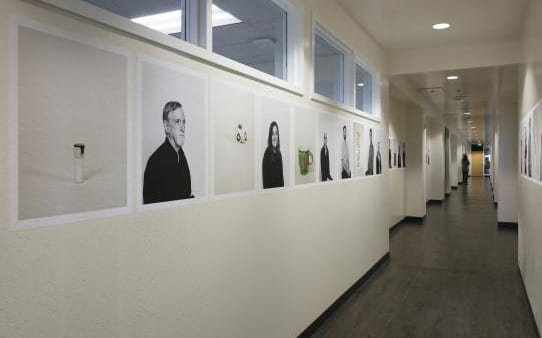
Intersecting Data Fields: An Art And Genomics Collaboration, at the Genomics Institute At UCSC Westside Research Park
Photo by Karolina Karlic We live in the midst of a disruptive age, where the face of culture and the nature of the human condition are rapidly changing. Intersecting Data Fields: An Art & Genomics Collaboration, uses photography as one of science’s most trusted agents for seeing and knowing what we might not otherwise have access…
-

Not ‘brains in a dish’: Cerebral organoids flunk comparison to developing nervous system
Additional authors included Walter Mancia, Diane Jung, David Shin, Denise Allen, Dana Jung, Galina Schmunk, Alex Pollen, and Tomasz Nowakowski of UCSF; Maximilian Haeussler, of the UC Santa Cruz Genomics Institute (pictured); and Jahan Salma of the Center for Regenerative Medicine and Stem Cell Research at The Aga Khan University in Karachi, Pakistan Widely used…
-

UCSC taking art/science LASER talk series downtown for special evening at Rio Theater
The Leonardo Art/Science Evening Rendezvous (LASER) is an international program of evening gatherings that brings together artists, scientists, and scholars for informal presentations and conversations. A program of the Leonardo International Society for Art, Science, and Technology (ISAST), the goal of the series is to feature compelling new developments in the arts and sciences, and to attract…
-

The case of an arctic wild ass highlights the utility of ancient DNA for validating problematic identifications in museum collections
Alisa O. Vershinina, Joshua D. Kapp, Gennady F. Baryshnikov, Beth Shapiro Molecular Ecology Resources | December 23, 2019 Abstract Museum collections are essential for reconstructing and understanding past biodiversity. Many museum specimens are, however, challenging to identify. Museum samples may be incomplete, have an unusual morphology, or represent juvenile individuals, all of which complicate accurate…
-

‘Does intrinsically good and bad technology exist?’ Bayer CEO says no: Davos 2020
Bayer CEO Werner Baumann highlighted “less and less trust in society for advances in technology” as a hurdle for pharma companies working on gene editing during a panel on genetic modification and engineering that took place at the World Economic Forum meeting in Davos, Switzerland. Baumann’s comments came after the panelists discussed He Jiankui, the…
-
Emerging field of ‘forensic genealogy’ links DNA testing and family histories to solve cold cases
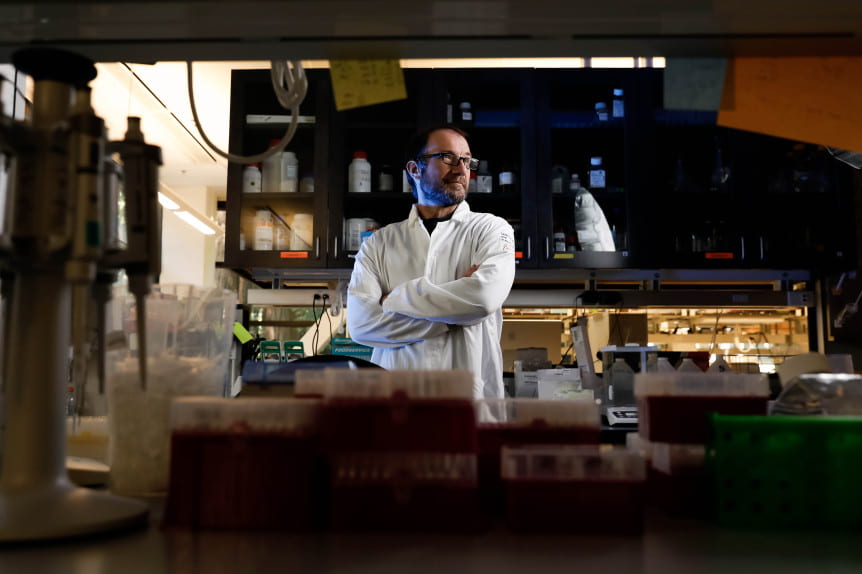
Richard “Ed” Green, an associate professor of biomolecular engineering at UC Santa Cruz, has developed tools to decipher ancient DNA, helping solve long-cold cases, (Randy Vazquez / Bay Area News Group) Amanda Heidt | East Bay Times | January 18, 2020 SANTA CRUZ — When they’re planning to rob a liquor store, most criminals think to…
-

Seagate, UC Santa Cruz collaboration poised to accelerate genomics data analysis
Initial focus of the collaboration by UC Santa Cruz Genomics Institute, Baskin School of Engineering at the University of California, Santa Cruz and Seagate will be accelerating the analysis of the Human Cell Atlas (HCA) EurekAlert! | August 27, 2019 August 27, 2019–Santa Cruz, CA — Seagate Technology (NASDAQ: STX), a world leader in data…
-
Highly Multiplexed Single-Cell Full-Length cDNA Sequencing of human immune cells with 10X Genomics and R2C2
Roger Volden, Christopher Vollmers bioRxiv | January 11, 2020 Abstract Single cell transcriptome analysis elucidates facets of cell biology that have been previously out of reach. However, the high-throughput analysis of thousands of single cell transcriptomes has been limited by sample preparation and sequencing technology. High-throughput single cell analysis today is facilitated by protocols like the 10X Genomics platform…
-

Off Earth Identification of Bacterial Populations Using 16S rDNA Nanopore Sequencing
Article | MDPI | 9 January 2020 Aaron S. Burton, Sarah E. Stahl, Kristen K. John, Miten Jain, Sissel Juul, Daniel J. Turner, Eoghan D. Harrington, David Stoddart, Benedict Paten, Mark Akeson, and Sarah L. Castro-Wallace Abstract The MinION sequencer has made in situ sequencing feasible in remote locations. Following our initial demonstration of its high performance off planet with Earth-prepared samples, we developed and tested an end-to-end,…
-
Distance Indexing and Seed Clustering in Sequence Graphs
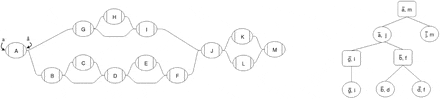
Xian Chang, Jordan Eizenga, Adam M. Novak, Jouni Sirén, Benedict Paten Cold Spring Harbor Laboratory | Dec 23, 2019 Abstract Graph representations of genomes are capable of expressing more genetic variation and can therefore better represent a population than standard linear genomes. However, due to the greater complexity of genome graphs relative to linear genomes, some functions that are trivial on linear genomes become…
-

A ligation-based single-stranded library preparation method to analyze cell-free DNA and synthetic oligos
Article | BMC Genomics| Published: 27 Dec 2019 Christopher J. Troll, Joshua Kapp, Varsha Rao, Kelly M. Harkins, Charles Cole, Colin Naughton, Jessica M. Morgan, Beth Shapiro & Richard E. Green Abstract Background Cell-free DNA (cfDNA), present in circulating blood plasma, contains information about prenatal health, organ transplant reception, and cancer presence and progression. Originally developed for the genomic analysis of highly degraded ancient DNA,…